Strategy
A working framework for the C-suite on how big AI builds, platform rollouts, and data architecture should run together

It does not matter if you have one AI project just getting off the ground or twelve running across several departments. Without a rough map of how the pieces fit together, you end up building a whole lot of inefficiencies around projects generally meant to make you more efficient. Ironic, right?
We see the same four patterns regularly
Departments build in isolation. Sales builds an AI tool, finance builds another, and six months later someone finds both managing nearly identical data in two different places.
Platform rollouts are sloppy. We have heard leaders say "I'll just flip the switch and see what happens." That invites shadow AI, inconsistent usage, and security holes nobody is managing.
A platform license gets mistaken for a strategy. Claude or ChatGPT alone can certainly help. But the real efficiency shows up with connected systems and agentic workflows, with humans deliberately in the loop.
There is no plan for how any of it fits together. Each project lives inside whichever department or person built it, with no system connecting them together or governance in place to make sure there is a cohesive strategy to tie them all together.
What separates a system from a pile of initiatives is not where you start, it's whether you build that piece to connect with the other two from day one.
Three major zones to consider
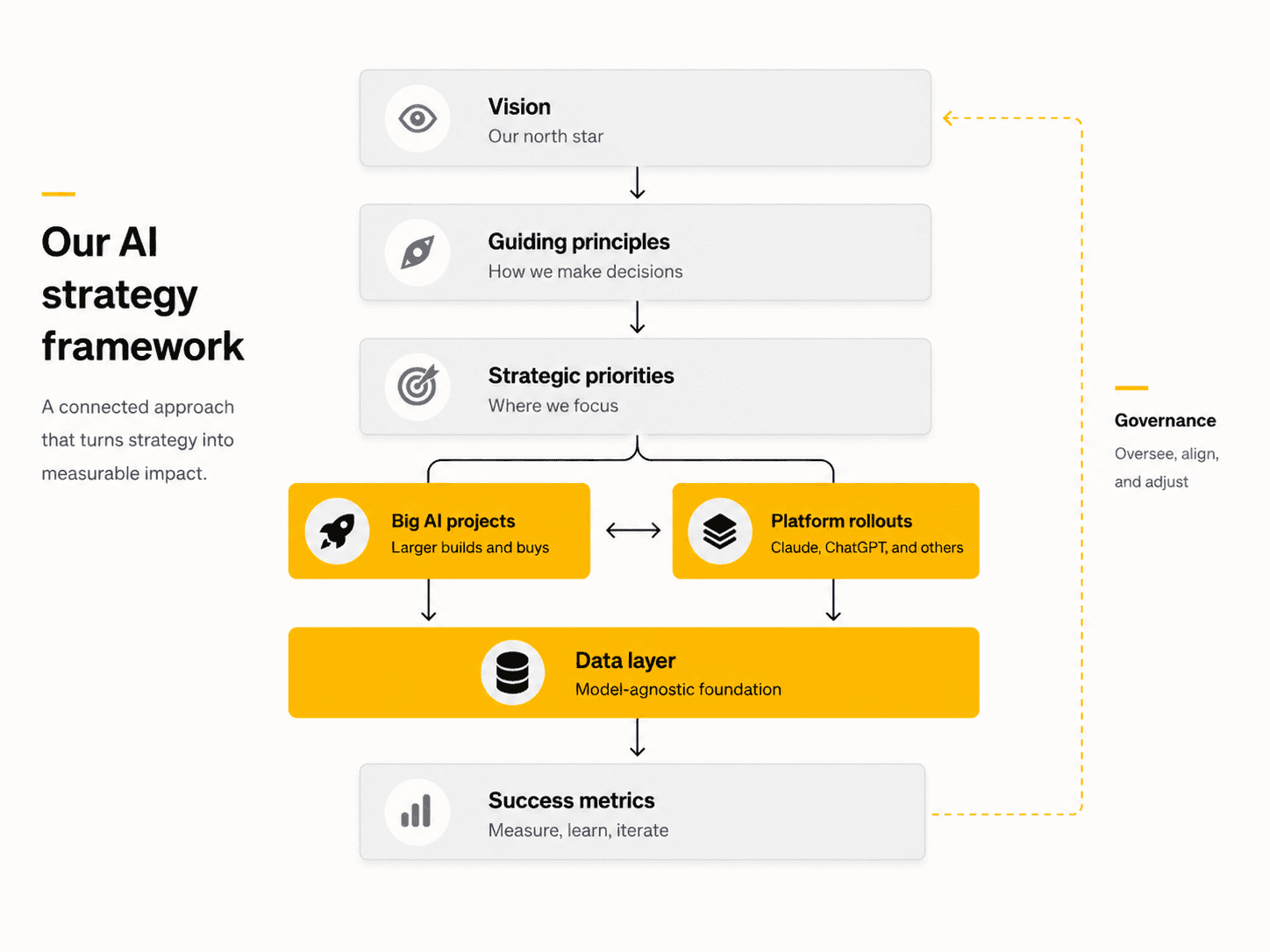
The full picture here includes vision and guiding principles. These only work when they connect to the company's overall strategy, not a separate AI vision running in parallel. Strategic priorities should map the same way, as sub-initiatives that ladder up to the business's actual strategic pillars. And success metrics close the loop by tracking real business impact, tied to governance and reported alongside any other strategic investment, not a side channel of AI-only numbers. That's the context for prioritization and the feedback loop that tells you whether a project worked.
This post, however, is about the three zones in the middle: big AI projects, AI platform rollouts, and the data layer. None of these is a phase you graduate out of. All three build momentum on their own, and eventually all three matter together.
Big AI projects
These are the custom builds and buys aimed at a specific, high-value workflow, ones that justify real investment because the payoff is concentrated in one place. Our estimator work with Buffalo Construction is a good example. We built it around the specific estimator workflow and integrated closely with their tech stack. We started with a defined scope and a delivery date attached to it, not an open-ended experiment.
That's the first thing that separates a real project from an expensive one: scope discipline. "Let's build something with AI" is not a business case. A defined problem, a clear owner, a fixed timeline, and success metrics built around ROI need to be set before you start. Our AI activation canvas is a good model for planning this out. This is what makes a larger AI project fundable and actionable, instead of a permanent slide in next quarter's deck.
Second, these projects only stay valuable if they can adapt. A custom build sitting on a locked-in or messy data foundation can create a long-term issue. It can break the moment the business or the underlying model changes.
AI platform rollouts
A successful AI platform rollout (ChatGPT, Claude, Copilot, etc.) is not a seat license and a training day. Done right, it's how you make your team AI-native, confident enough to invent their own workflows instead of waiting for someone to hand them one. We're running our own version of this internally right now, a structured push to get one AI-powered workflow live in every business function within 90 days, with someone specifically accountable for the program instead of leaving it to whoever's curious.
Two things make that actually happen. Structure: a real rollout plan and governance, not "flip the switch and see what happens." People need guardrails and some rigor to feel safe experimenting, not a free-for-all that turns into shadow AI and a security review nobody scheduled. And permission: the goal isn't compliance with a tool, it's a workforce that reaches for AI the way they reach for a spreadsheet, without thinking twice, and without waiting for IT to bless every use case first.
The dependency here goes both ways. Rollouts need the data layer to be more than generic chat. Without real data connected, a platform stays a smart assistant instead of a working tool for the entire workforce. And rollouts feed the big projects zone directly: the scrappy workaround someone builds inside Claude or ChatGPT to solve their own problem is often the first draft of your next custom build. Work moves both directions between these two zones. You can start a task in a platform and finish it inside a bigger build, or build something like a dashboard or an estimate as a custom tool and push it into the platform your team already lives in every day.
The data layer
Most executives or technology leaders we engage with already want to invest here or have projects in motion. The trouble is usually not motivation, it's not knowing where to start or how to appropriately structure the effort to scale.
You don't need a massive overhaul. Real progress happens with simple, unglamorous sources: an estimate spreadsheet, a CRM export, a product description buried in a shared drive, an accounting system nobody thinks of as an AI asset. What matters is less the source than the discipline around it: standardizing how data comes in, normalizing it into a consistent structure, and describing it in an open format both people and machines can read. Staying model-agnostic by design is what keeps that foundation interoperable. Vendor-neutral approaches like Google's new Open Knowledge Format, which captures organizational knowledge as plain markdown any tool or agent can read, or a portable, local-first vault like Obsidian, keep your data from getting locked inside a single platform or model. Keeping up with the blazing-fast pace of change around AI means you’ll want to be able to take advantage of model updates and new technologies as they become available.
This is the zone the other two need in order to scale effectively. It's what lets a workflow discovered inside a platform rollout go to the next level, and what lets a big project's output become something the whole organization can use inside the platform. Skip it, and the other two zones stay two islands no matter how good each one is on its own.
Governance is the engine, not a checkpoint
Governance is the engine that keeps the whole system pointed in the same direction. That does not mean a bunch of red tape that slows everything down. It means a lightweight org structure and communication system that manages change, elevates good ideas regardless of where they come from, and keeps the rollout, the builds, and the data work pulling the same way. Without it, you get a duplicated effort from the opening. With it, you get a system instead of initiatives that happen to share a budget line.
This is not theory, it is how we run our own business
At O3XO, we are running over a dozen AI projects across client work and our own tools. We built this framework out of necessity, not from a textbook. We have clients who started with a single platform rollout and are now several custom builds deep. We have others who started with one big project and are only now getting serious about data. Both are working. The difference is being deliberate about how it all ties together.
Where this leaves you
Vision, guiding principles, and strategic priorities are what decide which of these three zones gets your attention first. Then, success metrics are what tell you whether that bet paid off, or whether it's time to adjust the roadmap. That loop, prioritize, build, measure, adjust, is the other half of this system, and it's worth building deliberately rather than assuming it. If you haven't nailed that part down yet, that's a great place to start. You can read more about how we think about vision and principles on our about page.
Get all of it moving together, projects, rollouts, data, and the strategy that points them, and something real starts to happen. Momentum compounds. Teams stop reinventing the same tool twice. The organization starts moving like one system instead of a dozen separate bets. That's the whole point, and it's genuinely exciting to watch take shape.
If you're trying to figure out where to start, or how to get all of this pointed the same direction, let's talk.
Share